
|
|
|
| ROOTS AND TRADITIONS OF CAR DESIGN PROFESSION JAZZ
and CAR DESIGN
are not generally associated with one another, but both are AMERICAN ORIGINALS.
Lots of different melody makers' expressions form the creative roots and traditions
of Jazz, but the founding hymns
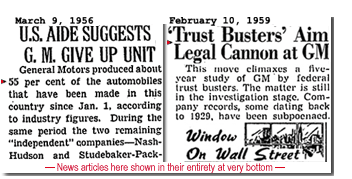
that launched the CAR DESIGN profession The Car Design Profession is the No. 1 reason GM and Detroit became so enormously successful throughout the golden heyday years of the 1950s and 1960s – and it's the number one reason America's auto world tanked so badly afterwards. By the mid 1950s, GM had so outpaced their competitors that the U.S. government tried, or considered, breaking up the company by declaring it a monopoly; as the 1956 New York Times article, at right clinically reports, "General Motors produced about 55 per cent of the automobiles." Missing entirely, however, is the primary reason behind the explosive auto sales boom: Design. Thankfully, most expert auto journalists did comprehend this, as Herbert Brean's vivid 1954 LIFE article demonstrates: "In auto sales, appearance is everything, or almost everything. It is certainly the most important single factor in a customer's decision to buy this or that make." It’s
well known that "when a big business prospers, the people prosper," There are literally hundreds, if not thousands, of news articles that boiled down on the same conclusion Brean's LIFE article reached right when Detroit was at the very top of it's game. How then could something heralded so high, the inspirational drumbeat of America's largest industry, at this time in history reverse course and completely go on to get lost? "GOOD DESIGN" CREATED GM'S MOST SUCCESSFUL ERA In 1927, when Harley Earl was hired by GM via Cadillac as a
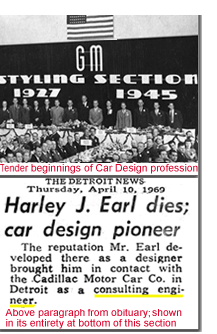
"consulting engineer," he didn’t just successfully style a
mass-production car, he mass-produced what was previously a piecemeal industry:
car design. His creation of a fledgling design department within General
Motors unified the humble beginnings of the Car Design Profession, and his
mantra of "appearance and function are of parallel importance" created
a new automotive paradigm. His new business theories, strategies and good taste principles
(along with those of Lawrence P. Fisher, head of Fisher Body and Cadillac
Motors) and his implementation of annual styling model changes crippled Henry
Ford's prestigious monopoly by making his utilitarian model obsolete. Design
became a powerful sales weapon, stealing Ford Motor Co.’s sales and market
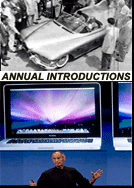
while turning GM into It
certainly wasn't lost on company leaders that Earl and Fisher's It was within Styling that each of GM's new
products were pre-engineered and pre-styled, and because this was such new
ground, an entirely new vernacular sprung up along with it, such as LIFE magazine’s
use of the word "BIRTH" (rather than, say, assemble) to
describe the complicated genesis of a GM car. Earl's production methods
were wholly math-based, organizing and simplifying the first stages of auto
engineering and manufacturing. Furthermore, as
demonstrated in Brean's and many other articles, new terminology
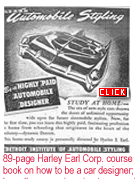
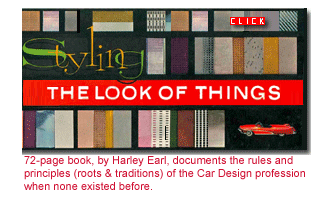
from the Earl's Styling handbooks (at left) were just being introduced, so
lots of media members and industry insiders began using what was inside to describe this new
process of auto building. HARLEY EARL'S VISION WAS HIS GIFT Here's a clear view of where Mr. Earl was positioned in 1956's auto world right after he and his Styling Section troops had just moved into the brand new General Motors Tech Center a few miles north of Detroit's city limits in Warren, Mich. Of course it wasn't all Harley Earl, for GM's new and advanced team of top executive players had been following their winning quarterback's moves now for a couple of decades and knew Earl made them far better players at the new game in town. They not only respected him for it (look at the photo below) but they were grateful what he had done for the entire industry.
By the Fifties, Mr. Earl's new profession had been wholly legitimized and Car Design became an incredible sword of power to any automaker willing to accept its credo of constant change and modernity. Car Design was non-negotiable for any automaker planning on selling cars in the world's largest marketplace, North America, which was now a fast-paced, design-obsolescence based market. As Nash, Hudson and Studebacker-Packard all exemplify (and it's mentioned in the 1956 NY Times news article further down), failing to create a sophisticated internal car design department akin to GM’s meant certain death. But perhaps its greatest asset was how this new hybrid-profession helped band together and organize auto leaders in design, finance and engineering so they all shook hands and got along, unconditionally to sell millions of products; Mr. Earl called this, "heightened cooperation." MOTORAMA - CUSTOMIZED SHOW CARS & EXPERIMENTAL CONCEPT CARS Recognizing that without change progress stagnates,
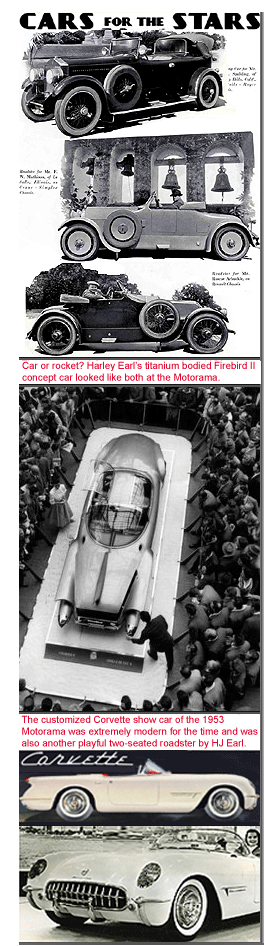
To understand Earl's entire legacy of customized cars, it's necessary to first mention his influential decade of designing between 1918 to 1927, a time when Harley turned out in excess of 1000 jaw dropping motoramic masterpieces (Mr. Earl said, "we were building 200 to 300 custom cars a year then"); many of which went to the very first family's of Hollywood, movie stars and film royalty millionaires. It was from this experience that Earl would then be able to go on to GM and make an enormous difference. Notice black&white photo, bottom right, shows silent film star great Roscoe "Fatty" Arbuckle in a small luxury two-seated roadster built on a Renault chassis. In all, Arbuckle ordered three hand-made custom car creations by Harley. Described by Earl as an, "all-new way of merchandizing," GM's multi-city, multi-year traveling Motorama road shows were one of the biggest hits of the '50s, and the inaugural January 1953 Motorama bore important offspring. A dazzling star of the show car event, CORVETTE immediately became a sensation. It was another one of Harley Earl's iconic babies, and he and GM's other leaders had already slated the sports car for production way back in the beginning months of 1952. That's why the very first Corvettes rolled off an assembly line so quickly five months later in June '53, right after Harley Earl debuted his first Corvette to audiences at the beginning of the year. The lineage of Harley Earl's iconic baby can first be traced back
to a Watkins Glen, NY sports car race in September 1951. After zooming around
the race field in his Le Sabre (another one of his dazzling show cars), he said,
"Watkins Glen, Le Sabre, that's where I got the idea for the
Corvette." Back in his studio in Detroit
he then nicknamed Corvette in its earliest stage as "Opel" on account
of the fact that Le Sabre's earliest central theme (development started in 1946)
had been aimed directly at the pre-war hubris of Germany's Mercedes Benz engineers nationally unified around the Nazi regime. The
calendar year of 1952 was Opel's infancy when Harley Earl personally designed
and then nurtured the idea, secretly of course, in front of other GM leaders
inside GM Styling's "Dream Factory" as the auto media of the day used
to like referring to the newest hi-tech region of the company. Meanwhile, the
stock price and overall fortunes behind GM are zooming skyward and this was the
moment Harley Earl named his newest Custom Car, "Corvette."
Afterwards, with the rest of its brethren, the "art" as Harley Earl
used to call the stars attending his motoramic masterpiece collection of
Motorama vehicles, were on the road being trucked off to Fast forward a decade later to 1963, Harley Earl's sports car
creation was on the fast track to becoming," America's only true sports
car" with a legacy of turning into a true phenomenon. Over the next 50 years, this one car brand swelled into a mountainous wave, driving
millions of consumers into Chevrolet showrooms to look and buy. To say there is
an unparalleled amount of professional jealousy surrounding " A CHANGING OF THE GUARD THAT ROCKED THE AUTO WORLD The meteoric winning streak of GM's mid-twentieth century leaders lasted from 1927 to 1958; remarkably, even during the Depression GM gained reams of market share, primarily from Ford and Chrysler. This 31-year time span was a true Golden Era during which General Motors' achievements and milestones broke the molds, set unprecedented records in the auto and big business worlds, and paved the way for future industry leaders both in and outside of GM. Given their perfect positioning in the late 50s, why didn't GM – and all of Detroit along with it - continue in a positive direction? The
answer is simple: a complete change in leadership. Between September and
November of 1958 the most powerful executive positions switched hands and GM’s
reversal of course can be pinpointed to the transitioning of their leadership
mantle. Albert Bradley, CEO, and Harlow Curtice, President, both resigned on
August 31, 1958, with Fredrick Donner and Jack Gordon respectively replacing
them on September 1st.
Two months later, William Mitchell took up Harley
Earl's acting role as Vice President of GM Styling on November 23rd. A recent August, 2012 Star-Telegraph newspaper story titled GM's Donner 'Party' fleshes out the cannibalistic mentalities of GM's new leaders and exposes myriad weaknesses of this new administration: "Fredrick Donner, the first GM CEO to have gained the position without ever having run any of the corporation's major divisions." Beyond exposing Donner as being extremely inexperienced, it reveals Donner’s "festering resentment" of his predecessor, detailing that Donner "was not a fan of Harlow Curtice." In addition, Gordon held a profound dislike towards anything-Harley Earl. For example, when Gordon headed the Cadillac Div. coming out of WW Two he waged battle against Earl and his tail fin idea sprouting forth on GM's flagship brand; the rift is even mentioned inside Earl's Detroit News obituary where the tail fin creator mentions how his design idea, "almost started a war inside the corporation"). The
ushering in of these three leaders marked the end of what Harley Earl called
"heightened cooperation," whereby GM's newest top leaders in design
(Mitchell), finance (Donner), and engineering (Gordon) simply did not come
together in the interest of creating the best possible products. Human nature
being what it is, there was of course always competition, ego, and the flaring
up of petty differences but far overshadowing that was these leader's not having
any desire to create professional camaraderie between employees, and to cater to
their customer's wants and needs. Furthermore,
the 2005 book,
Encyclopedia of White-Collar & Corporate Crime author Lawrence
Salinger exposes how each one of these new GM leading Donner's
sentiments were representative of what soon became a pervasive mentality and
just as much as other reasons are cited for the beginning of GM's demise. The
following (Ralph Nader's campaign against the Corvair being brought on by GM's attempt at
what many reporters called "blackmail", the oil crisis,
globalization, etc.), change in corporate culture played an enormous role
in the company coming crashing down. Company culture is created from the top
down and the chip on these three leaders' shoulders created decade after
decade of jealous feuding based on greed and hubris. Donner, Gordon, and Mitchell were no doubt daunted by the impossibly large shoes they suddenly found themselves having to fill, and what easier way to do this than to minimize their predecessor's accomplishments and take false credit. Here's a perfect example in the form of a scathing February 10, 1959 newspaper article, below, showing how out of touch and misguided GM's newest leaders truly were right from the get-go of their administration. Notice second paragraph stating, "company records dating back to 1929, have been subpoenaed" and it doesn't take a rocket scientist to figure out that GM's newest Wiz Kids were about to usher in what would later become a well known way of covering things up; GM's top leaders began a new industry trend for Big Business to follow and that is of, "shredding valuable corporate documents." It was like GM's new leaders started writing what would become the corporate criminal's handbook on how not to get caught. This article also has a feature, bottom of middle column, titled, Targets for Lampoons establishing how these charlatan leaders were fair game to be laughed at from now on in. Let's simply not forget, the reason GM's previous leaders didn't get treated this way, is that they had commanded respect and deserved it by all their deeds and accomplishments, etc...not to mention, GM's staggering volume production efforts to help win WW Two.
Before the changing of the guard, GM held great significance for the state of Michigan and also for the welfare and progress of the United States, not to mention the world. After Gordon, Donner and Mitchell stepped in the opposite unfolded and became true by the end of the 20th Century. During this decade's long period, most all of GM's leaders played the same irreverent musical cord that tore down what had once been so sacred to the leaders who cemented GM and the American auto industry at what is now perceived as the very "top" of the auto world. In
destroying the very things that created their towering success, however, also
eliminated their blueprint to succeed in the future, and the auto industry's
pioneering modern roots and traditions of the Car "Paying
tribute to the pioneering spirit and mankind's ongoing quest for improvements.
The urge for change -- spiritual, political or economic -- was the motivating force that brought the earliest settlers to our
shores," said Harlow Curtice in his commencement speech at the dedication
ceremony of the GM Tech Center in May, 1956. He finished saying, "It
propelled our pioneers westward, cleared our farmlands, built our great cities, Only after Earl's death in 1969 did GM's leading executive core go on to do something fundamentally different regarding GM's design legacy (which basically is the legacy of America's Car Design Pioneer) and Bill Mitchell played right along with the closed book agenda. It wasn't illegal or anything like that, but this company's leaders began cooking GM's history books in order to make themselves, and the "New GM" they were running look good in the public eye. Of course it was insidious, so was the first major downward path Detroit's auto world started heading in during the tumultuous 1970s. Moving forward thereafter, this despicable tactic became an ace-in-the-hole for elite GM execs to pull out of their treasure chest whenever they needed a quick fix. As strange as it may seem now, these leaders simply believed no one would care in the first place, let alone ever figure out the subterranean scheme of reinventing GM's authentic design legacy moving forward. Truth be told, it exacerbated the new down trend in America's auto capital and undermined the foundation behind the Car Design business. After which, GM's product designs did not reflect Earl's guiding rules, principles and traditions. Going down this wrong path weakened and set America's auto world back in time. Fast forward to a relevant October 3, 2012 FORBES article titled, As The Country Goes, So Goes General Motors further helps a modern audience better understand what this writer, Martin Sosnoff, reports, "GM's market share started its long, downward slippery slope in the late sixties at 48 percent market share, some 44 percent in the seventies and 40 percent in the eighties. It dropped alarmingly to 32 percent in the nineties and pretty much has bottomed out at 18 to 19 percent presently." Mr. Sosnoff's prognostication of, "pretty much has bottomed out" is merely another market timing expert's bet who, like so many before him over the last fifty years, has foolishly been proven wrong in "bottom picking" one of the world's largest business downtrends. Only through radical new changes (and new discoveries on the facts regarding what cemented GM and Detroit at the "top" of the auto world, once) in leadership will America's auto capital truly begin to bottom out and turn around. 1956 report on GM's monopoly status:
Most obituaries reported Harley Earl being the pioneer of the car design profession:
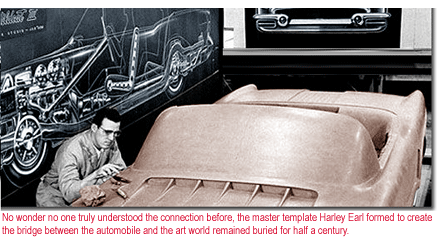
No wonder no one truly understood the connection before, the master template Harley Earl formed creating the bridge between the automotive and the art world remained buried for half a century. |




























 created
new industries and new ways of life for all of us. Continuing emphasis on change,
on a better method and a better
product, in other words, on progress in technology, has been the major force
responsible for the growth and development of our country."
created
new industries and new ways of life for all of us. Continuing emphasis on change,
on a better method and a better
product, in other words, on progress in technology, has been the major force
responsible for the growth and development of our country." 

