|
|
|
|
Precious few great American stories remain untold and this website is devoted to preserving and promoting the heritage of a lesser known yet enormously influential innovator. The Automobile Design profession
was a field that
revolutionized the auto world and permanently
changed the face of capitalism. Harley Earl's accolades include such iconic
business milestones
as the annual model change,
the world's first concept car, dynamic obsolescence, first to introduce clay
modeling to the auto world, the Corvette, the first-ever
onboard computer in
an automobile, and the standardization of secrecy in car design. "Few every have the opportunity to see the
inside of a professional design studio, since secrecy is a necessary part of the
process," was one
of Earl's favorite maxims.
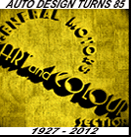
Cambrian Explosion In 1927, Harley Earl put "design" on the business map by creating the very first corporate department, Art & Colour, committed entirely to expertly designing all GM's products. By 1937, Earl's department was the primary reason this company was rapidly gaining new market share. Soon after, Earl was elevated to corporate vice president status and consequently he renamed his new department the GM Styling Section. Although many were resentful, this was a time when legions of GM's engineers and auto execs finally "got it" (along with all GM's major competitors) and realized the big money that was at stake and started following the lead of the auto world's first design superstar: Harley Earl.
Today, "driven-by-design" or "appearance and function being of parallel importance" rules the success or fate of any large auto manufacturer. One man -- Harley Earl -- changed all this and that's why each modern worldwide auto maker (from Mercedes, BMW, Audi, Toyota, Nissan to Honda, etc...) has a central automotive design department, ruled by a VP of Design, structured inside their respective corporation's upper management hierarchy.
In
the beginning, prior
to Earl’s arrival in America's automotive capital, Henry Ford’s famous quote
summed up the industry’s opinion on car design in Detroit: "you can have it any
color as long as it’s black." There were no design departments and words
like style, design or beauty simply were not a part of the industry's vernacular. Like the
introduction of any significant change or new business paradigm, Harley Earl’s
steadfast belief that design was the No. 1 reason for car sales was met with
hostility, ridicule and resistance. Until he designed a companion car for the
Cadillac division of General Motors: LaSalle.
LaSalle brochures were the very first to showcase "design," emphasizing the term's importance to the auto industry and general public alike. New Era When
Earl design-engineered the La Salle for the Cadillac brand of General Motors, its unprecedented first-year sales figures stunned the automotive
community.
Convinced of Harley’s vision of the auto industry future, GM’s largest
shareholders staked Earl to start a new area within their company: Design.
GM’s offer meant leaving Hollywood, CA where he had grown up and already
created enormous success in the car business. As the designer of hundreds of
custom cars for what read like a who’s who of Tinseltown (Fatty Arbuckle,
Cecille DeMille, Mary Pickford, Al Jolson to name a few), Harley ran a
profitable and high-tech auto design manufacturing plant. Seeing the opportunity
to make a historic difference, however, he moved his family to Detroit in 1927
and quickly began creating his dream: the auto world's dependency on design. Once Harley’s innovative new auto styling methods were implemented at GM, Henry Ford’s utilitarian approach became obsolete and before long the use of Harley’s colorful two-dimensional drawings and life-size clay models was industry standard. Within a decade, Ford’s auto empire had significantly dropped from their No. 1 position while GM became the dominant player rapidly approaching a 50 percent market share before America entered World War Two in 1941. Entering
the post WW II years, Detroit – and by the 1960s the whole world – was
dependent on Earl's new ultra-modern volume "dependency on design"
production methods and Harley’s once-mocked notion that automobile design was
the number one reason for car sales in America was now considered common
knowledge. Reading a piece written by him in 1938, the breadth and depth of his
understanding of the industry is apparent, and Harley Earl’s unity of art,
science, and showmanship remains the worldwide standard: Out of the merger of art, science and industry have come new techniques that have within themselves the ability to create an entirely new pattern and setting for the life of the world. Mention the word "art" to a roomful of people and most of them will think of a great painting. Some will think of sculpture or architecture – a few, of music or literature. But hardly anyone will think of industry. For art in industry is comparatively new. Only in recent years has the interest of manufacturer and user alike been expanded from the mere question of "Does it work?" to include "How should it look?" and "Why should it look that way?" Appearance and style have assumed equal importance with utility, price and operation. The artist and the engineer have joined hands to the end that articles of every day use may be beautiful as well as useful. Every civilization has contributed something of importance to man’s understanding of the principals of beauty. It remained for our own times, through new forms of skill, to provide the means by which artistic creations are made available to everyone. Probably in no field have the results of the application of art to the products of industry been more apparent than in the that of the automobile.
Quantum Leap Comparing the
original framework of the 1927 La Salle to the daring aerodynamic design of the Firebird, it's clear to see how in just thirty years time, Harley took the auto
world on an artistic and engineering quantum leap. How many times have you heard the phrase "As GM goes, so goes the nation"? How often have you come across someone referring to "America’s love affair with the automobile"? These common sayings epitomize American culture in the twentieth century and remind us of a heritage that we struggle to retain. And this tradition probably would not exist if not for one man — Harley Earl. Harley Earl came to General Motors in 1927 and retired in 1958. During that time, he turned the business of designing, mass-producing and marketing automobiles on its head. With the possible exception of Henry Ford, no other person has single-handedly contributed more to the evolution of the modern automobile industry.
As one can see above, Earl's reach goes deep into the heart of every modern car made today. While introducing new guidelines on the art form of modern day Motor Car Designing, Harley Earl made the following statement showing how the design engineer must know what is underneath before he or she can design the covering, or envelope, known as the body: LEONARDO DA VINCI, the great Florentine artist, demonstrated that in order to arrive at a satisfactory portrayal of the human form the artist must possess a knowledge of anatomy – especially of the bones and muscles that make up the structure of the body. As in the case of the automobile, mechanical improvements, too, have contributed to improved appearance. In fact, it is rather an accepted principle that as a product is improved functionally, it tends to become better artistically.
1954 Bonneville Special Small Cars Continuing in this innovative vein, in 1957, GM's Styling Section began work on the 1960 Chevrolet Corvair, a new and radically different design for American manufacturers. The Volkswagen Beetle, along with other small Japanese import cars, was becoming popular among economy-minded U.S. drivers and Harley Earl intended to create competing compact cars. Moving into the 1960s, Earl envisioned millions of American consumers driving beautifully manufactured, small, modern cars like the ones depicted below.
Earl's vision, however, was never realized. Just as they disagreed with his "radical" notion that design was the number one reason for cars sales in America, GM company leaders dismissed Harley's idea that small cars were the future of the auto industry and refused to break from their tradition of "Building Big Cars Forever." This proved catastrophic to the American auto industry, by the time they realized how grossly they'd misread their consumer audience, small foreign cars flooded the North American market place and GM was in a sharp decade's long decline. Read a timeless Harley Earl article on building smaller cars in America, click below:
This 1950 "Growing" Stops for Automobiles report details a significant battle behind the controversial Small Car vision Earl predicted. Since it was never realized, at the time, it went on to play no small part in the dramatic fall of America's greatest auto maker. A magnet for mythology, Harley Earl is still an an auto industry legend and many know him as an iconic business pioneer for engineering consumer demand/desire for modern automobiles like no other leader. It's ironic that Earl shed light, so long ago in the modern era, on the very essence of what eventually toppled General Motors in the 2008/2009 bankruptcy, "It's a matter of record that poor styling or improperly timed styling has proved financially disastrous to some automobile manufacturers."
An ultra-modern truck, bus and an advanced styled 1959 Cadillac design above point to how if Harley Earl had never moved from Hollywood, CA. to Detroit, MI. "to make a difference" the world as we all know it today would be a duller place.
Conclusion The
American auto industry is at a precarious crossroads where it can either make a
dramatic turnaround or lapse into automotive obscurity. Harley left in place a
paradigm for exceptional automotive design and now, more than ever, it’s
critical for Detroit to revisit the innovative roots and proven traditions from
its heyday. By unearthing the lost legacy
and mystique of Harley J. Earl, a man who truly devoted his life to the bettering of the
American automotive industry, this site intends to inspire new leaders.
Through the language of vision – which knows no boundaries – this website will continue introducing exclusive segments on the untold side of Harley Earl's life and work. From a kaleidoscope of historic images, reel footage and audio clips to a vivid storyline, we intend to supply everything imaginable.
|