
|
|
|
|
GREAT DESIGN REINS SUPREME During
the heyday years of GM's modern rise to the top there was an explosive sequence of highly successful
product designs coming off
all the company's
assembly lines. Among other self propelled vehicles, Harley Earl's Styling
Section designed The specific accomplishment of the responsible head behind all of GM's trains from this above mentioned time frame, built in the Eltro-Mototive Division (EMD) plant in LaGrange, Illinois, is a well documented fact and can be seen in different articles of the era and many of Mr. Earl's obituaries, too. A 1956 Styling Section brochure, further down, details the recitation of facts, "The products designed by GM Styling include household appliances, earth moving machines, railway cars and locomotives, trucks and exhibits as well as automobiles for Cadillac, Buick Oldsmobile, Pontiac and Chevrolet Divisions." As one can see, there's a certain accountability
that Mr. Earl's modern paradigm (one part being the 'dream car' method, or in
this particular case, it's the 'dream train' procedure) playing an instrumental
role in
taking General Motors way out in front of it's competitors.
The
scholarly
information here, on how GM's modern trains came to life, focuses on "what made GM and America's auto industry great during the '50s
heyday years" also allows a more comprehensive understanding of Harley Earl
and his team's performance. This kind of history is the best type of analysis,
for the flip side of
the coin is what's been put out in the public domain over the last twenty-five
years. What's been primarily written on our nation's Car Design Pioneer was coordinated
by Detroit's auto leaders from 1983 thru 2008 and they were directly accountable for
a giant overall decay of the industry, not to mention the worst 25-year market share performance
in the history of American auto industry
record keeping! Fortunately, many die-hard car lovers these days freely post internet opinions and notions on what America's Car Design pioneer would do if he were reincarnated, "If Harley Earl were around today he would be trumpeting how mediocre or poorly designed transportation products turn off and mock a savvy American public, and to a certain degree, compromise our country's resolve and long-term strength. And, why on earth would any good American ever want to stand in the way of this kind of progress or what Earl once said was, "the process that creates the demand for new products; that sets the factories in motion?" "
Click above to see train designs by Designer-Earl and/or click below to read an unbiased media report
View GM Styling's first clay models of this extraordinary double-decker Greyhound bus
Pictured above and being presented at the widely popular Motorama Show, is the interior of a 1956 'dream car' from Earl's hybrid engineering dream-house known as GM Styling. It clearly demonstrates what was coming next; telephones, TVs, and reel-to-reel tape players would be integrated and introduced into millions of GM's cars starting in the not too distant future (sometime in the 1960s). Earl's promise back then, was like JFK saying America was going to land on the moon by the end of the 1960s. It was something you could bank on, so by the 1970s GM Styling would have really been ready to Rock & Roll and push the envelope of progress. What went wrong? Everyone alive today in America knows the future Harley Earl promised us never happened. Instead we are all too familiar these days with the legacies of leadership in Detroit that followed after Earl's design-engineering sword of power was snuffed out at the end of the 1950s. Within a decade's time, millions of dull designed vehicles coming off of all GM's assembly lines led the way and America's mass audience of car buyers, from the 1970s to the end of the 1990s, had no other other option but to jump ship and start buying millions of foreign auto maker's products. In Earl's heyday at GM, a poorly designed car would have never made it beyond the acid test of being built into a full scale clay model and being visually inspected by him and other subordinate "good taste committee" members of GM Styling. After Earl's retirement, it was a whole new ball game - what went into production and then came off all of GM's assembly lines (originally designed in GM Styling) came down to what ever new product design had stuck up on the wall the longest inside GM Design. Not seen in Detroit's auto world since the 1920s, chaos returned and ushered in a new era for America's auto world. The standards were no longer raised, and of course a polar opposite direction unfolded and poorly engineered and awkward looking cars, and America's trains, became the norm.
Click below to read about GM's first, "Train of Tomorrow" streamliner
Click here to find about GM's highly publicized second "Train of Tomorrow"
|


























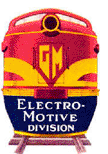 every one of GM's most important slip-streamed trains of the 1930s, '40s and
'50s. But, like so many other key factors of this man's wheel of
creativity, much
of the recitation of facts, like where and how all GM's mid twentieth century
trains first came to life, went on to be simply buried in an avalanche of
hearsay in the 1960s and thereafter.
every one of GM's most important slip-streamed trains of the 1930s, '40s and
'50s. But, like so many other key factors of this man's wheel of
creativity, much
of the recitation of facts, like where and how all GM's mid twentieth century
trains first came to life, went on to be simply buried in an avalanche of
hearsay in the 1960s and thereafter. 

 No
wonder Mr. Earl's legacy of building products so well has
such a hazy patina surrounding it and most people today have a foggy recollection
that
America even had a "Car Design profession" or a "pioneer"
responsible for it's rise in the first place. Sure this area of the industry is the most intoxicatingly elaborate segment of auto
making (the domain inside every auto maker where the car is born; i.e., the art
and engineering first come together). All this
culture, and the roots and traditions of what Harley Earl founded, is unique and
needs to be properly
preserved for future generations.
No
wonder Mr. Earl's legacy of building products so well has
such a hazy patina surrounding it and most people today have a foggy recollection
that
America even had a "Car Design profession" or a "pioneer"
responsible for it's rise in the first place. Sure this area of the industry is the most intoxicatingly elaborate segment of auto
making (the domain inside every auto maker where the car is born; i.e., the art
and engineering first come together). All this
culture, and the roots and traditions of what Harley Earl founded, is unique and
needs to be properly
preserved for future generations.


